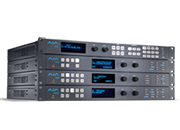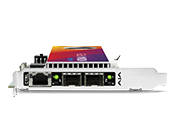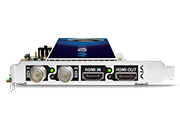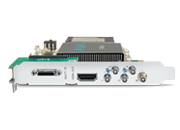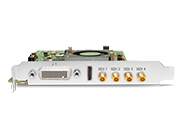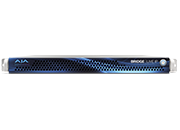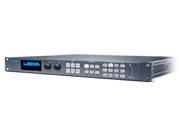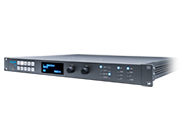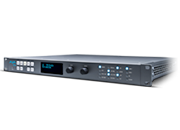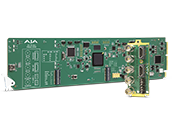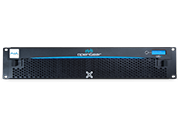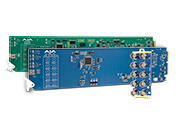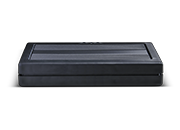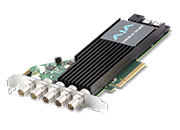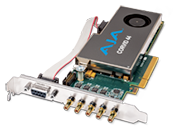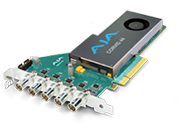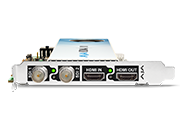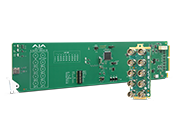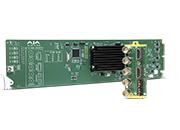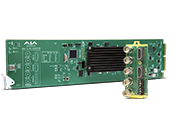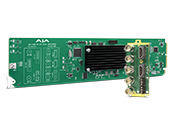
FS8

FS8

Hybrid SDI/IP Media Processor

Schedule a Demo

$14,995 US MSRP*

* Plus any applicable tariffs. Pricing is for US only. International pricing will vary.

Overview

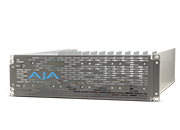
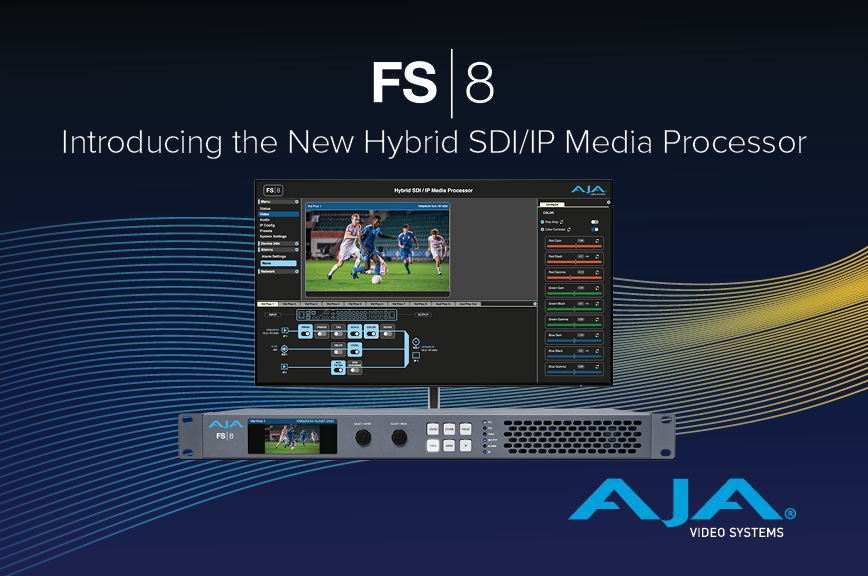
The FS8 is the new powerhouse multi-channel frame synchronizer and converter engineered to prepare SDI and SMPTE ST 2110 signals for production. FS8 combines frame synchronization, up/down/cross-conversion, frame-rate conversion, HDR/WCG processing, 3D-LUT-based and live color management, audio processing, delay management, and metadata handling, along with SDI to/from IP gateway, in a single, 1RU device. It is designed for cine-live productions, broadcast, production trucks, flypacks, live venues, studio and remote production environments where every downstream device must receive a predictable, standards-compliant signal, ensuring interoperability in even the most complex workflows. 

FS8 features 8 independent channels of HD video processing with up to 4 channels of UHD video processing in an all new, easy-to-operate, visual node pipeline within a rich web interface. The video processors are fed from up to 16x 12G-SDI inputs (8x 12G-SDI BNCs plus 8x via optional SDI HD-BNC or Fiber SFPs) and 8x HD or 4x UHD ST 2110-20 (4x 25 GbE SFP) inputs for a total combination of up to 16 inputs. FS8 has full input and output signal routing, allowing any I/O port to be assigned to any processing channel. Audio connectivity has also been expanded from embedded SDI and MADI with the addition of Dante audio and ST 2110-30 audio connectivity building a massive 459x448 mono audio matrix! 

Designed to solve real production challenges, the FS8 has a robust suite of tools for configuration and troubleshooting signal paths including a built-in test signal generator with custom text overlay on each output for verifying processing and downstream routing without adding additional sources. FS8 presets reduce set up time with System, Vid Proc, Audio Proc, IP Config, and 3D LUT presets available. In addition to its web-browser based UI, the FS8 can be managed via the REST API by 3rd parties or customized control applications. ST 2110 discovery, registration, and control is available with NMOS IS-04, IS-05, and EMBER+. Redundant power supplies ensure reliable, mission-critical operation. 

The partner ecosystem offers integrations with external hardware controllers from CyanView and Skaarhoj, as well as compatibility with Pomfort software for real-time look management.
 

Product Features

Product Video

FS8 Video Product Introduction

Watch this short video to get a high-level introduction of the FS8 with AJA Senior Product Manager Tim Walker. Discover how FS8’s powerful hybrid SDI/ST 2110 workflows, video and audio processing, and routing capabilities simplify today’s multi-camera, multi-format, multi-color space production workflows.

SMPTE ST 2110

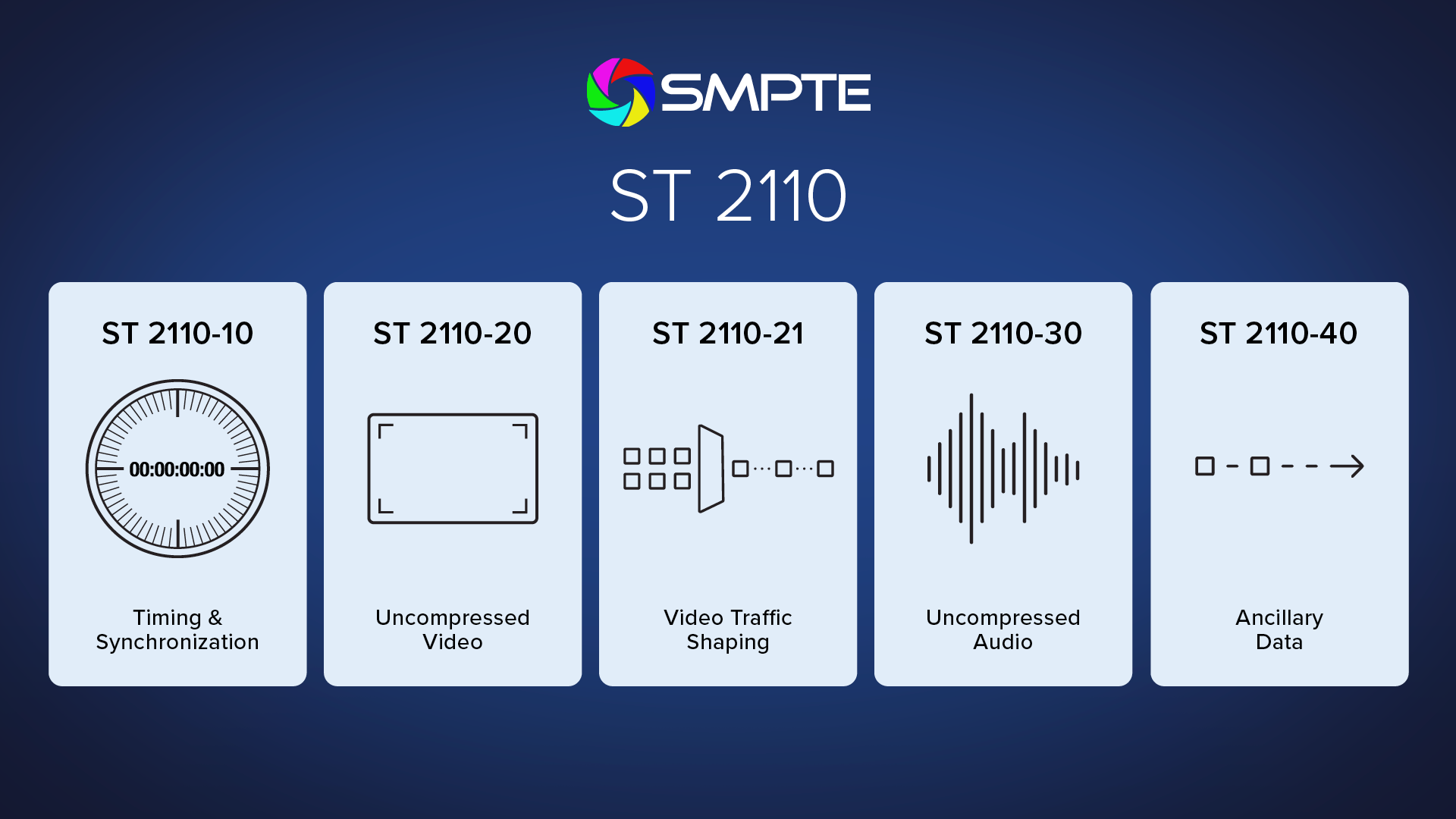
AJA’s SMPTE ST 2110 product family provides the connectivity, control, and interoperability needed to build scalable, standards-based IP production workflows. With four SFP28 cages, the FS8 supports up to 4x UHD or up to 8x HD ST 2110 streams. The two pairs of SFP28s support ST 2022-7 redundancy for maximum uptime. FS8 supports hybrid IP gateway workflows in which SDI and SMPTE ST 2110 signals are synchronized, converted, processed, and exchanged within the same platform. The FS8 can input SDI, apply frame sync, and a wealth of processing options such as SDR/HDR conversions, ROI, scaling, and then output SDI and ST 2110 streams. It also supports conversion from ST 2110 to/from SDI or stay in a full SDI or 2110 pipeline providing ultimate flexibility in dynamic production settings. The capability doesn’t end with signal processing, the FS8 can use PTP and generate a wide range of analog sync reference outputs to genlock other devices. It also features in-band and out-of-band control via NMOS IS-04 and -05 and Ember +. 

HDR and Color Management

HDR, SDR, and Wide Color Gamut Processing 

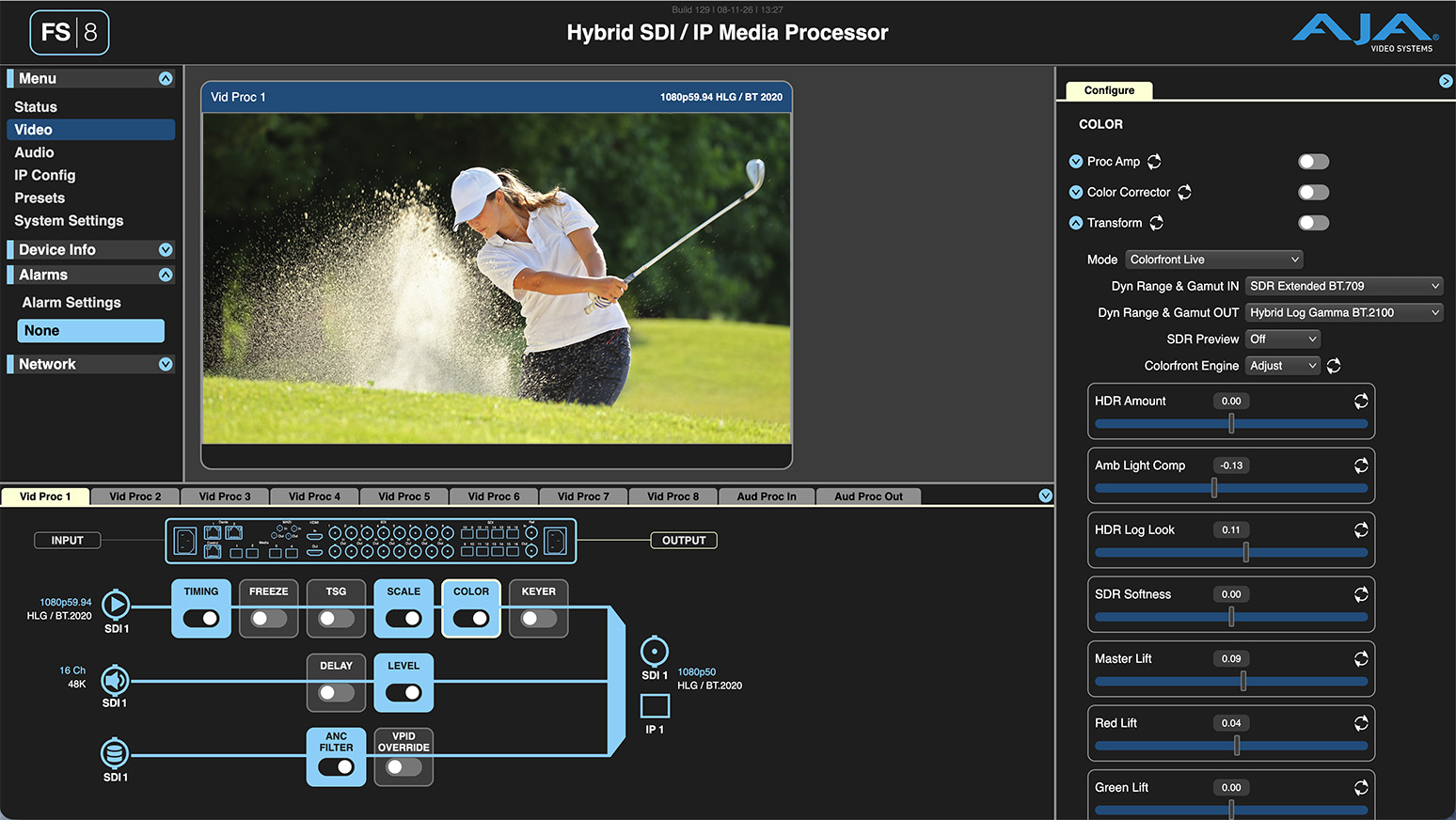
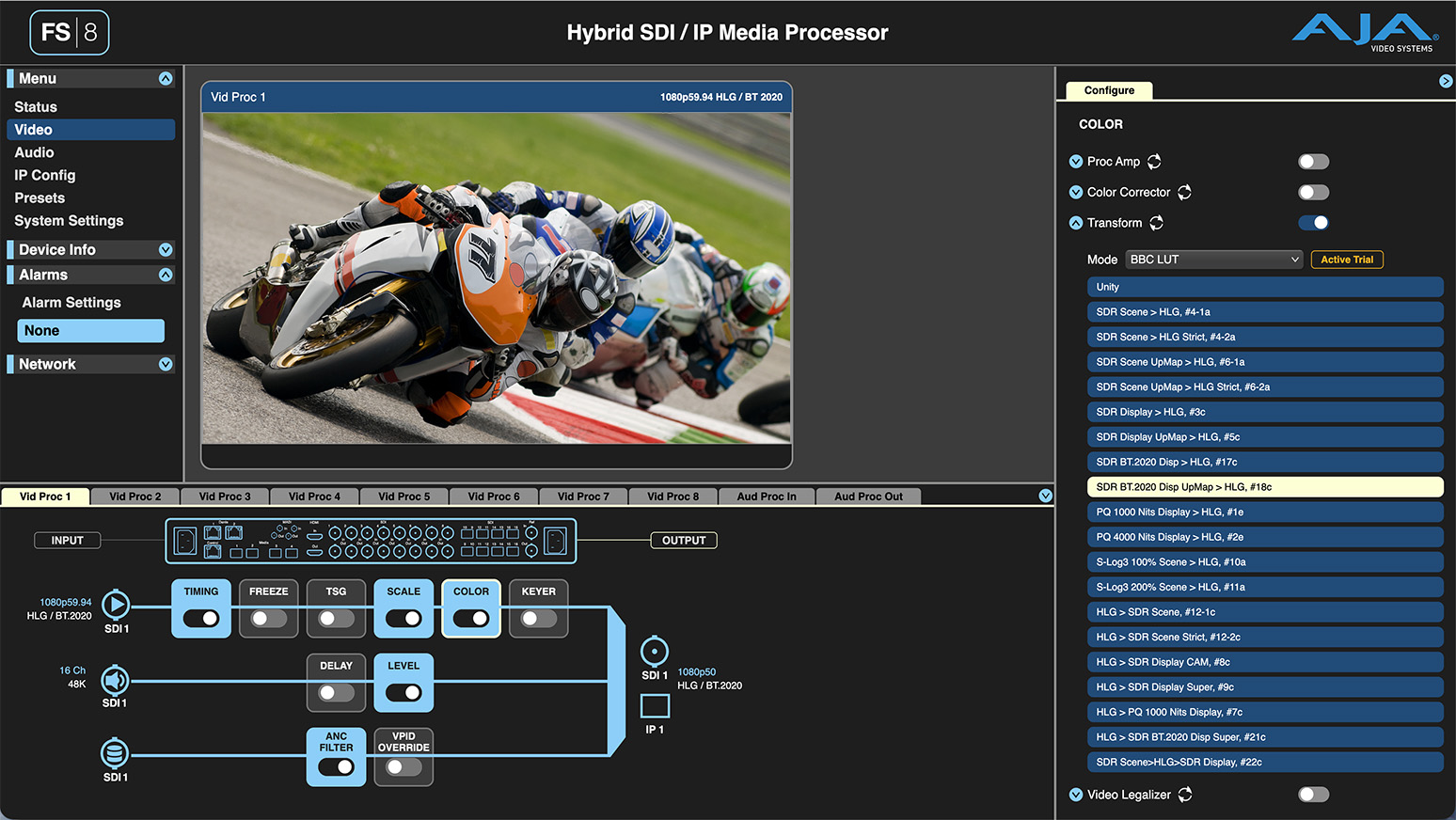
FS8 supports real-time HDR, SDR, and wide color gamut conversion for live production and distribution. Starting with the proven strengths of FS-HDR, the FS8 includes transform-based processing supporting 3D LUT workflows and single stream HDR productions with SDR and HDR deliverables, while expanding flexibility across more channels and hybrid SDI/IP paths. 

Live Color Management and Creative Control 

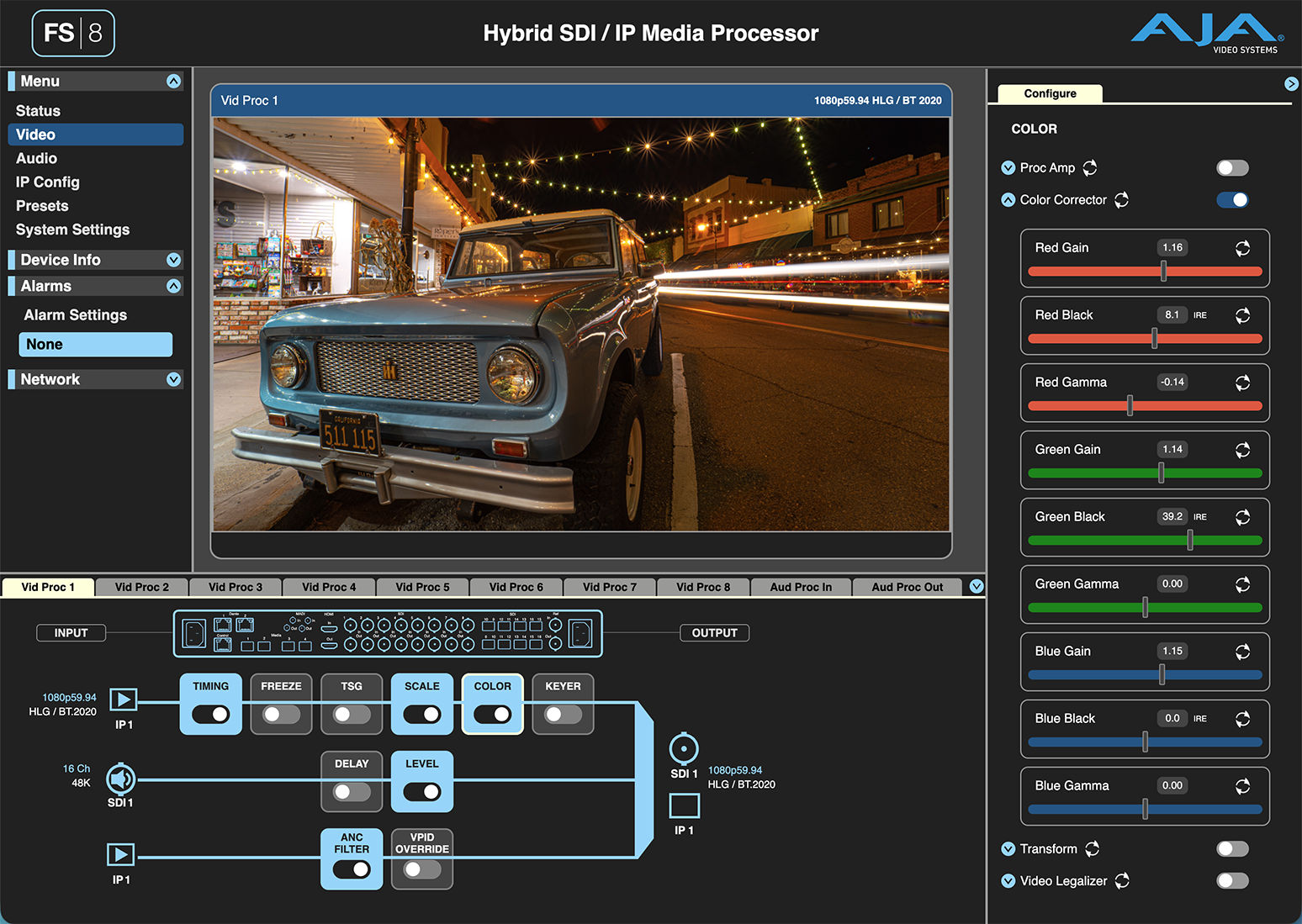
For camera matching, live grading, and HDR look management, FS8 provides configurable 3D LUT processors and integration points for professional live color-management systems. A Pomfort Livegrade workflow allows color decisions made in a live production environment to be applied in real-time.  FS8 has a per channel Proc Amp and RGB color corrector in line to fine-tune your live looks or camera match. The FS8 features color management from Colorfront*, NBCU LUTs, and BBC HLG LUTs*.

Single Stream HDR and SDR production 

Productions often must generate multiple color-space and dynamic-range deliverables or convert SDR sources to HDR for mixing with other HDR sources. FS8 can apply different color transforms per video processor output while preserving timing and generating the correct signaling metadata. A single source can be routed to multiple Video Processors for coordinated HDR and SDR processing and route to SDI and/or ST 2110 outputs using the internal signal routing matrix. 

Legalizer

Finally, a built-in YUV/RGB legalizer ensures the processed video remains within broadcast specifications, protecting live productions and deliveries from illegal luminance and chroma levels after color processing, HDR transforms, and format conversions. 

*Optional license required. Free 15-day trial available. 

Operational Simplicity - Control for Operators, Engineers, and Automation 

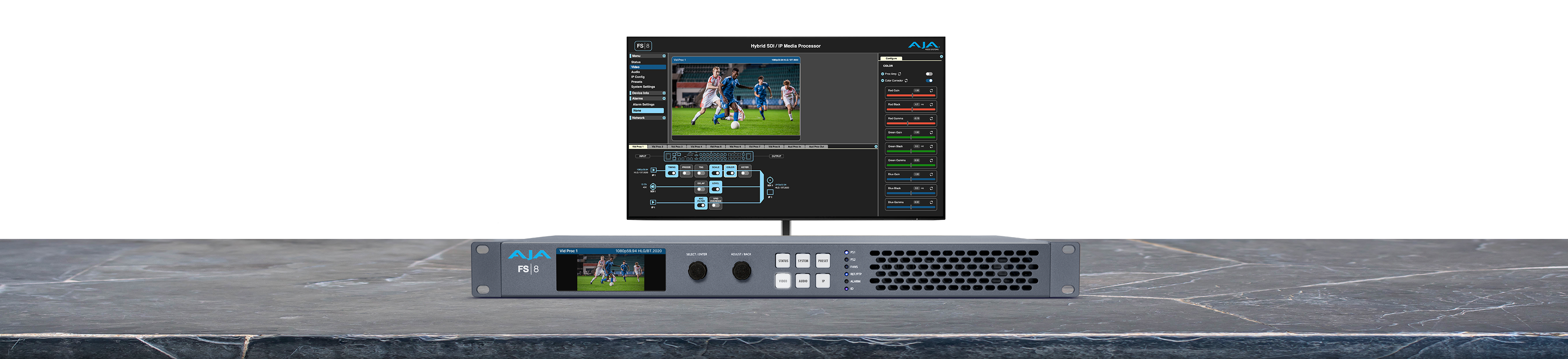
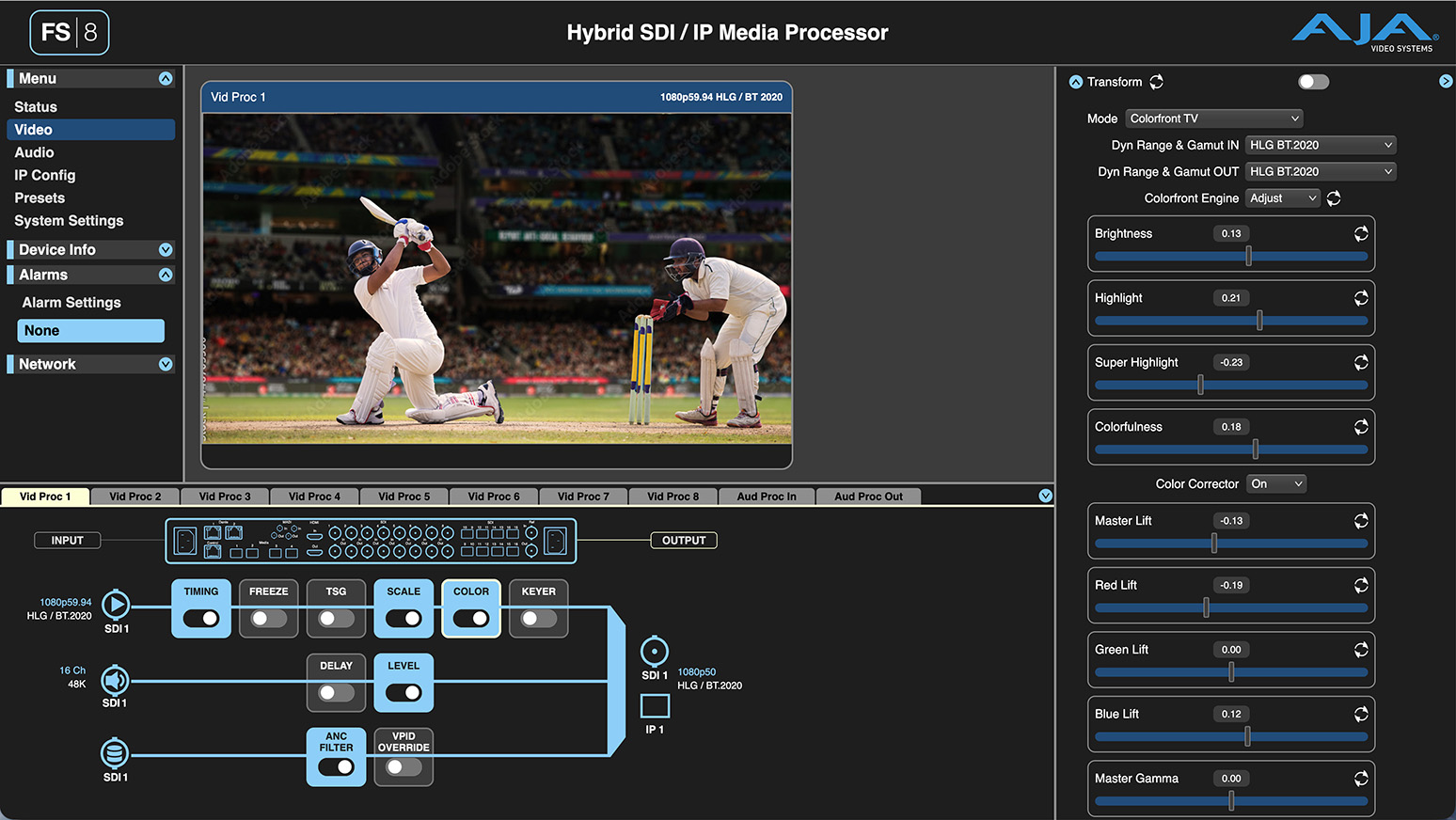
FS8 features an embedded web server and an easy-to-use web UI, making sophisticated signal processing intuitive to configure, control, and deploy simplifying complex SDI and IP workflows while allowing engineering to maintain visibility and control. The interactive node-based processing pipeline and video preview provides the visibility, and control operators need to work with confidence. 

FS8 offers an advanced preset experience with System, Vid Proc, Audio Proc, IP Config, and 3D LUT presets available to the end user.  Each preset type offers granular control over each part of the preset you want to recall.  This greatly simplifies large scale deployments where defined processing pipelines can be shared across multiple units.

NMOS IS-04 and IS-05 supports automated device discovery, registration, and stream connection management within SMPTE ST 2110 environments. 

The OpenAPI Specification (OAS) for the REST API is easily available for 3rd party or customized control, with integrations available from CyanView, Skaarhoj, and Pomfort. 

Ember+ support enables seamless integration with broadcast control and automation systems for remote monitoring and operational control. 

Frame Synchronization and Timing Control

Precisely Align Every Signal 

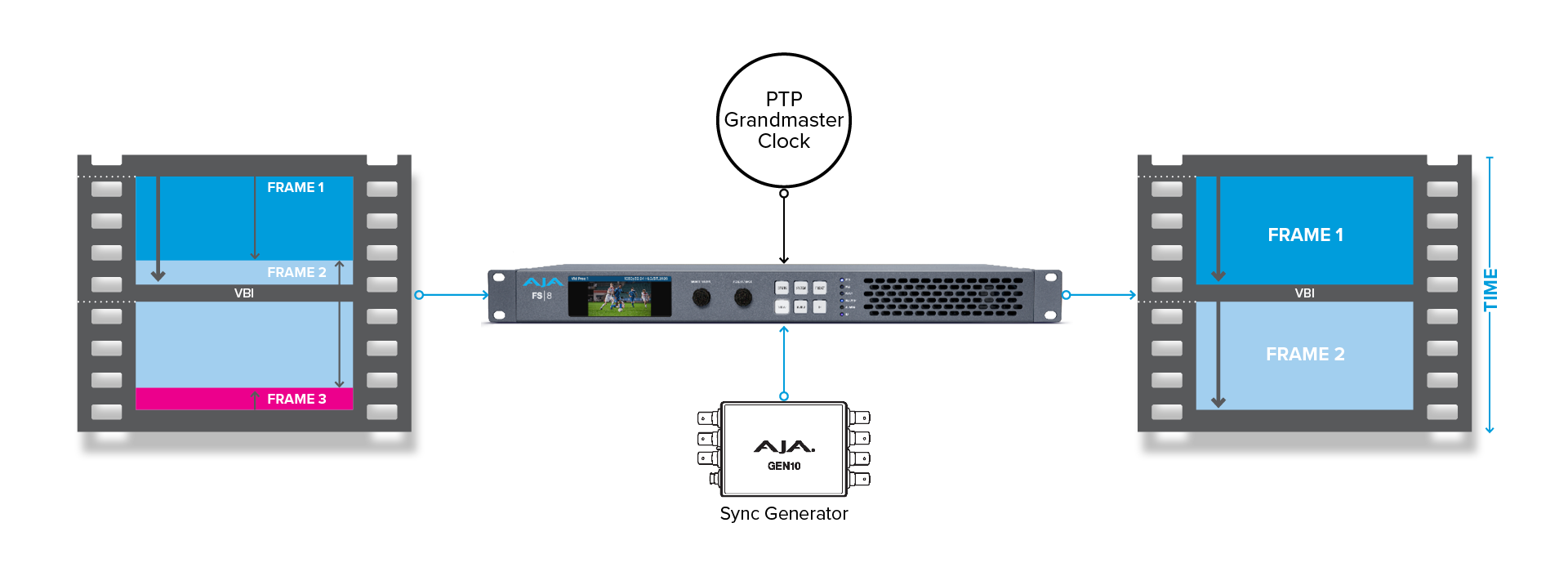
Cameras, replay servers, graphics engines, encoders, and processing equipment rarely deliver signals at exactly the same instant. Each video processor in the FS8 aligns an untimed or asynchronously timed source to house reference or PTP timing. Adjustable output timing and frame delays compensate for latency elsewhere in the workflow, allowing signals from different processing paths to arrive together. FS8 provides horizontal, vertical, and frame-delay adjustments, allowing engineers to align signals from the pixel level to multiple whole frames. Frame delay can be set to ultra-low latency for color procession only, for example, with just half of a video frame of processing latency. 

As sports fans have come to expect more dynamic and interactive experiences, augmented reality (AR) is a common and valuable production asset, but one that requires additional video processing time. For seamless integration of AR into live productions, larger frame buffering capacities are required to delay other sources. The FS8 offers the largest configurable frame delay in its class of up to 60 frames per video processing channel in HD (30 in UHD), ensuring all sources stay in time. 

The web UI offers a timing comparator which describes reference to output delay and input to output delay. The combination of these tools provides everything you need to manage signal timing in to and out of the FS8. 

Frame Rate Conversion 

When working in IP or Hybrid (SDI/IP), FS8 can do anything-in into anything-out frame-rate conversion with a utility frame drop/repeat approach as it is locked to time/PTP. In pure SDI workflows, the video processors frame-rate conversions will be locked to the incoming reference. For example, if you are locked to a 50Hz analog reference, input a 59.94p signal and convert to 50p, it will drop frames as needed and output a locked and aligned signal to the 50Hz ref. Please see the manual for more details. 

Video Capabilities

FS8 offers a robust and wide range of video processing options with an easy-to-use, intuitive, node-based web UI. Eight independent video processors provide an extensive toolset for normalizing and shaping incoming signals including frame synchronization, up, down, and cross-conversion, layering, and color management for 4K, UHD, 2K, and HD sources. SDI and ST 2110 connectivity makes FS8 equally at home bridging existing baseband infrastructure with IP workflows, operating entirely within either environment, or integrating existing SDI infrastructure within IP environments. 

Up/Down/Cross-Conversion 

AJA’s advanced video processing delivers high-quality up/down/cross-conversion while preserving image fidelity throughout a ST 2110/SDI hybrid production pipeline. Dedicated 10-bit hardware processing delivers consistent image quality with reliable and repeatable performance. Key conversion features include: 

  • 4K/UHD/2K/HD up/down conversion 
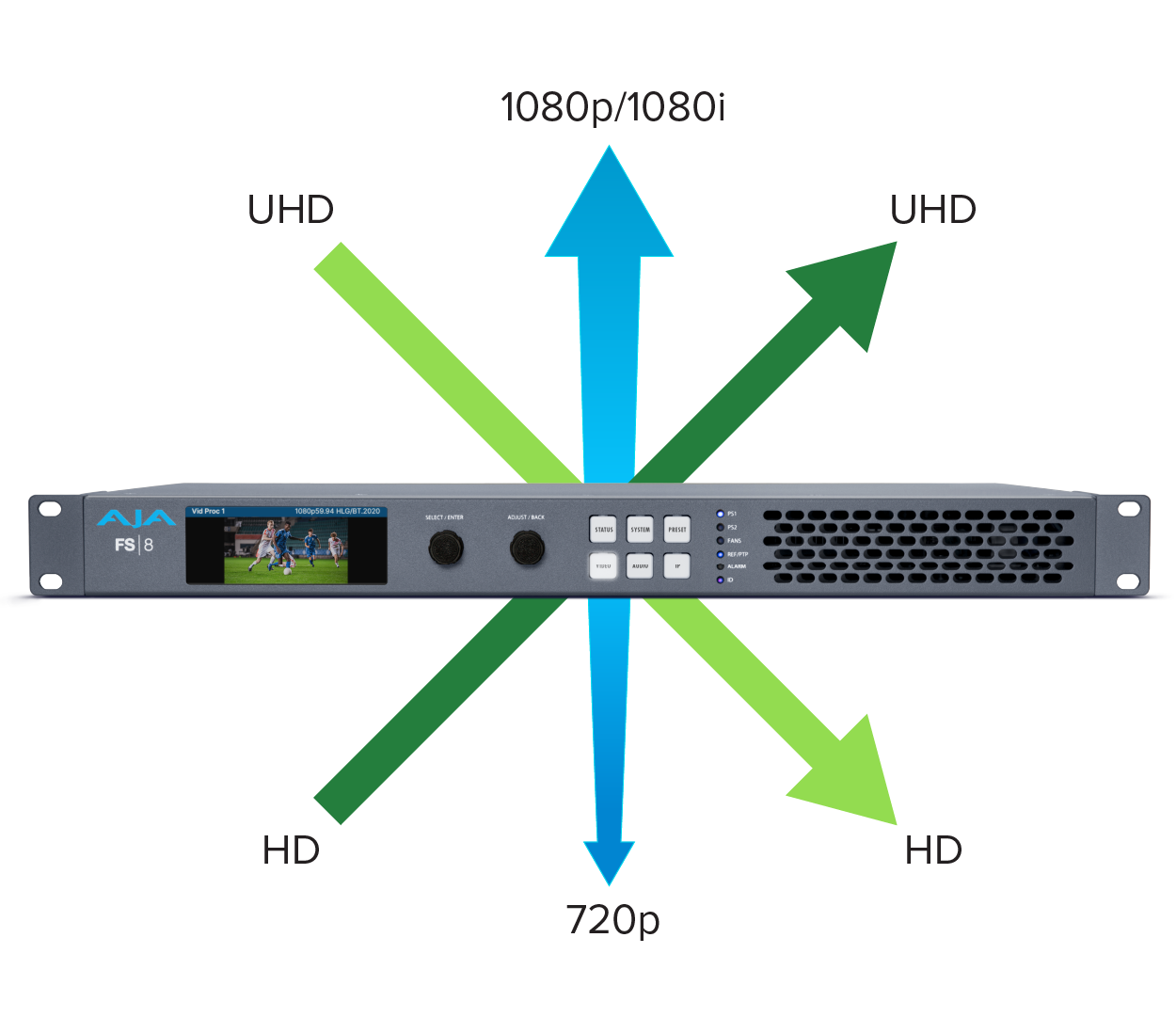
  • HD/HD cross-conversion (720p/1080p/1080i)

Frame Synchronization 

Configurable video delay up to 60 frames in HD and 30 frames in UHD, plus an ultra-low-latency mode of less than half a video frame, gives engineers the flexibility to precisely align complex production workflows or simply process video as fast as possible. AR (Augmented Reality) imagery is fast becoming a de-facto standard for high-end sport production requiring massive delays of other signals, and FS8 has the tools to keep your diverse production elements in sync.

Region of Interest Scaling 

The FS8 gives you powerful image shaping tools with adjustments for crop, scale, horizontal and vertical positioning - functioning as multiple high-powered 4K ROI’s embedded in this versatile media processing device. 

  • Adjust size - shrink or zoom, maintain aspect ratio  
  • Select Region of Interest and scale  
  • Crop 
  • Horizontal and vertical positioning 

Multi-Layer Video Processing 

The FS8 has a built-in layering engine where you can layer one video processor behind or next to another and fill in the background with a matte color in this flexible layout tool, with an output preview in the UI. 

  • Matte generator used to fill background, sidebars, letterbox areas, or masked regions after scaling 
  • Clean masking of non-image areas 

Audio Capabilities

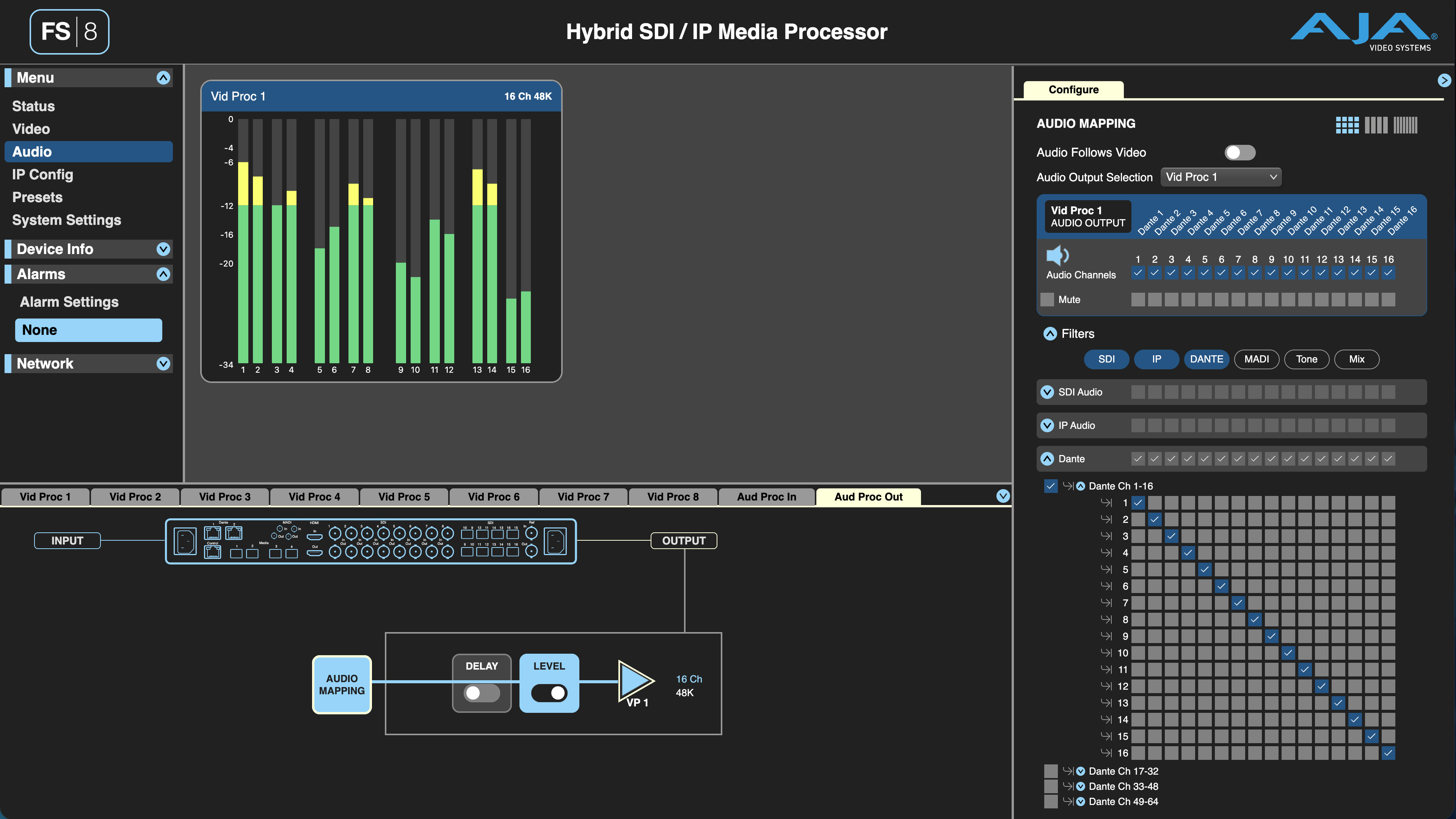
Powerful video processing is complemented by an equally comprehensive set of audio processing, routing, and synchronization tools. The FS8 includes a large internal audio matrix, sample rate conversion, per-channel delay, gain, phase, mute, mixdown, embedding/de-embedding, and test tone generators so audio can remain synchronized and correctly assigned as video is processed. The FS8 offers Dante and ST 2110-30 IP audio, adding to the AJA Frame Synchronizer family’s comprehensive audio management capabilities. 

Audio In – up to 459 possible inputs

  • SDI embedded, ST 2110-30, MADI, Dante 
  • High-quality Sample Rate Conversion (SRC), each channel processed at 48kHz 
  • SRC bypass for non-PCM audio 
  • 250ms of delay, level and phase controls for each input channel 
  • Audio downmixers for surround to stereo downmix 
  • Test tones

Audio Out - up to 448 possible outputs

  • Map any 128 channels of audio to any of the 8 Vid Procs, routed to 16 video outputs* 
  • Map any 128 channels of audio to MADI outputs 
  • Map any 64 channels of audio to Dante output 
  • Additional 2500ms of delay, level. and phase controls for each output channel 

 *(ST 2110-30 audio is associated with ST 2110-20 video) 

Hardware

Connectivity

The FS8 has two pairs of 10/25GigE SFP28 cages for optional ST 2110 I/O with 2022-7 redundancy and PTP supporting IP workflows. In SDI workflows, FS8 utilizes standard BNC as well as optional SFP with optical or HD-BNC inputs and outputs to integrate easily into 12G-SDI infrastructures. The SDI fiber I/O option allows fiber cable runs up to 10 kilometers to be directly connected to the FS8 without the need for separate fiber converters. An analog reference input allows the FS8 SDI outputs to be locked to your house reference signal. Using timing derived from PTP, FS8 provides a configurable analog reference output which can be used to genlock other devices. The Control Port is for accessing the web UI and out-of-band controls. Dante audio I/O is over the Primary and Secondary GigE ports for Dante network redundancy and control via Dante software. MADI I/O is via the two pairs of HD-BNCs. Dual redundant power supplies are included supporting continuous operation in mission-critical applications.

  • Video  
    • 16x16 SDI (up to 12G-SDI) 
      • 8x8 BNC 
      • 8x8 SFP (optional) 
    • 4x4 UHD or 8x8 HD ST 2110-20 
      • 4x SFP28 for 10 or 25GbE (ST 2110-20 with ST 2022-7, optional 3rd party) 
  • Audio 
    • 256x256 SDI embedded (SDI Only Mode, 128x128 in Hybrid Modes) 
      • 8x8 SDI BNC (16 channels per video) 
      • 8x8 SDI SFP (16 channels each per video, optional) 
    • 128x128 MADI  
      • 2x2 HD-BNC (64 channels per MADI) 
    • 128x128 ST 2110-30 
      • 4x SFP28 for 10 or 25GbE
      • 8x8 UHD or 4x4 HD (16 channels per video, optional 3rd party) 
    • 64x64 Dante 
      • 2x RJ-45, Primary and Secondary (64 channels) 

Operating Modes and IP Gateways 

Operating Modes and IP Gateways 

FS8 offers different operating modes tailored to different production needs.  

SDI Only Mode is for an all-SDI facility and will benefit from all available 16x16 12G-SDI I/O (including optional SFPs). 

Hybrid 1 Mode is for a hybrid facility working with both SDI and ST 2110 signals and offers connectivity to 8x8 SDI (BNC) and 8x8 HD or 4x4 UHD ST 2110. 

Hybrid 2 Mode is for a hybrid facility which requires both SDI over fiber and coax and offers connectivity to 8x8 SDI (optional SFPs) and 8x8 HD or 4x4 UHD ST 2110. 

In either of the two Hybrid Modes the IP gateway capabilities include: 

  • 8x HD (where "x" is a gateway in or out) 
  • 4x UHD  
  • Examples: 
    • 8+0, 4+4, 0+8 HD (where 8+0 is 8 IP inputs to 8 Vid Procs to 8 SDI and or IP outputs and 0 SDI to IP gateways) 
    • 4+0, 2+2, 0+4 UHD 

Front Panel - LCD Display and Controls

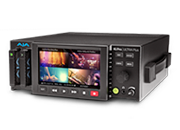
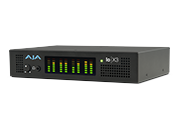
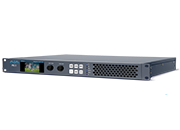
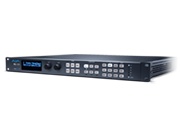
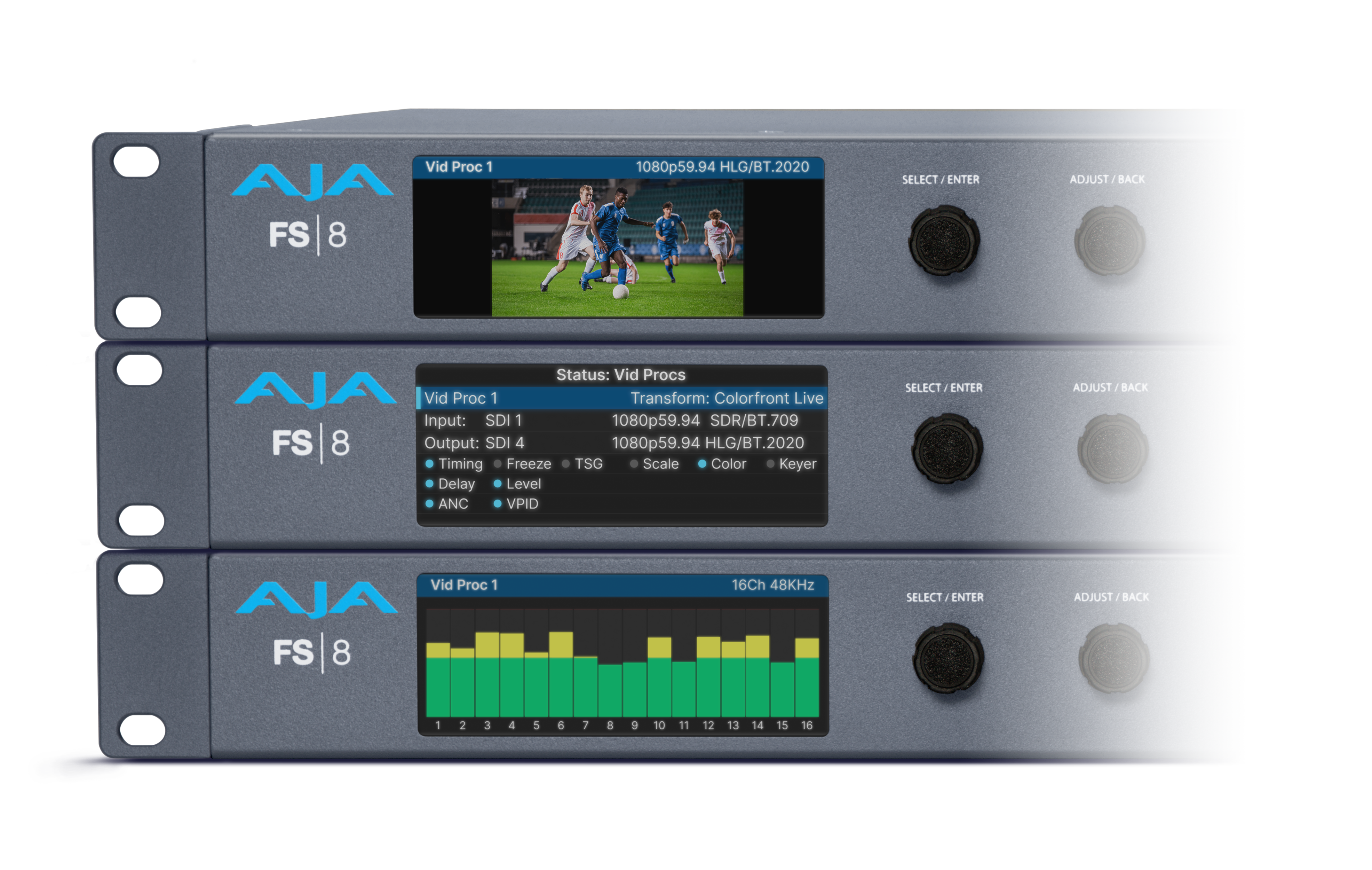
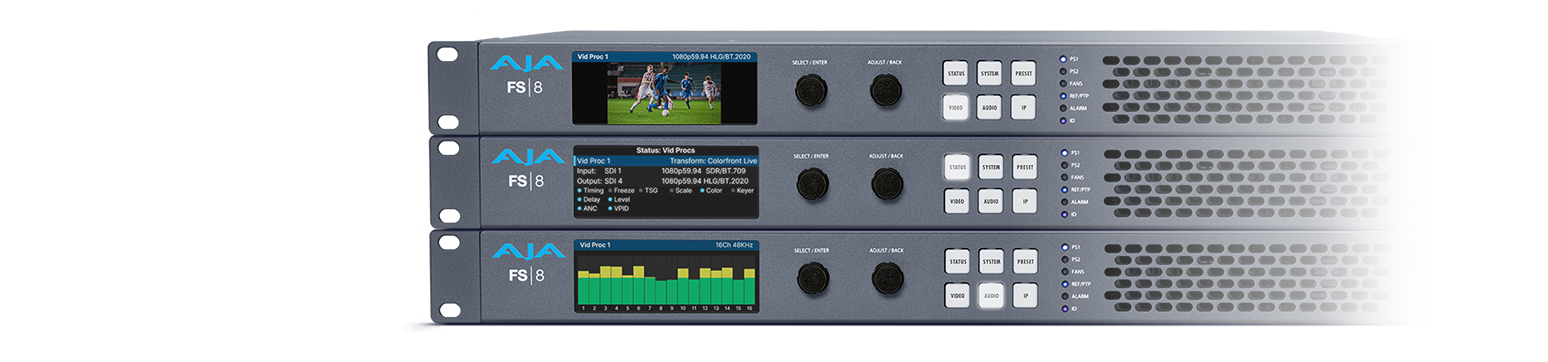
The FS8 front panel offers a color LCD display with real-time video processor output preview, audio level meters, and status for quick confidence monitoring in addition to critical system status monitoring including PTP. On the front panel, you will also find the select and adjust knobs, display navigation buttons, and status LEDs.

Workflows

FS8 Hybrid SDI-IP Infrastructure

FS8 bridges existing SDI infrastructure with modern SMPTE ST 2110 production networks, providing high-density frame synchronization, format conversion, HDR/3D LUT processing, ANC handling, and integrated audio management in a single 1RU platform. With support for SDI copper and/or optional fiber I/O, ST 2110 over 4x25GbE, embedded audio, Dante, and MADI, FS8 helps facilities simplify signal flow, reduce equipment count, and transition confidently between baseband and IP production environments.

Click workflow to enlarge.

Download Workflow

FS8 Live Production/REMI Edge Processing

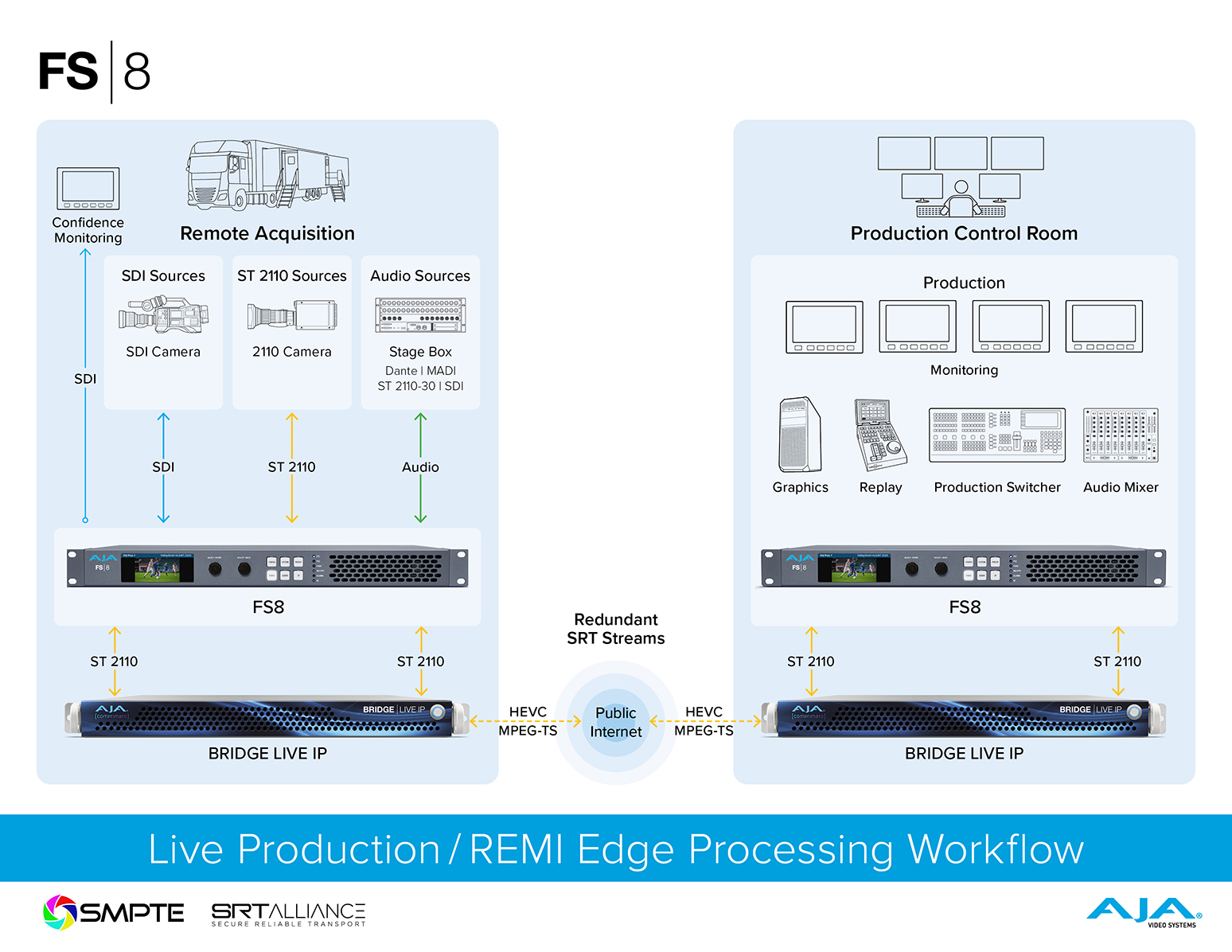
FS8 helps simplify live REMI workflows by aligning SDI, ST 2110, and audio sources at the remote acquisition site before they move into production. Paired with BRIDGE LIVE IP, processed feeds can be transported as redundant SRT streams over the public internet, then received at the production control room where the actual production occurs. 

With integrated frame synchronization, video processing, and audio handling, FS8 provides a compact edge-processing point for live production teams working across SDI, ST 2110, Dante, MADI, and remote contribution workflows. 

Click workflow to enlarge.

Download Workflow

FS8 LED Wall Low Latency Color Management

FS8 provides centralized, low-latency color management for live LED wall workflows. Multiple UHD HLG BT.2020 sources from graphics, replay, switcher, and camera systems are processed through FS8 and converted to UHD PQ BT.2020 for delivery to LED image processors and displays. Integration with Pomfort Livegrade software enables dynamic image control across the workflow, while FS8 provides the processing density to manage up to four UHD signals in a single 1RU system.
FS8 simplifies color management across multi-display productions while maintaining the low latency required for consistent, responsive imagery across stadium, on-set production, concert, and corporate event displays.

Click workflow to enlarge. 

Download Workflow

HDR and Color

Colorfront Engine™

Maintaining Perceptual Integrity

FS8’s HDR/WCG capabilities leverage video and color space processing algorithms within the Colorfront Engine, specially licensed by AJA from Colorfront as a licensable option for FS8. 

Powered by the Colorfront Engine, FS8’s extensive HDR and WCG processing support enables real-time processing of up to 8 HD or 4 UHD signals. FS8 also enables the conversion of popular camera formats from multiple vendors into the HDR space, plus conversion to and from BT.2020/BT.709 as needed, critical for HDR/ SDR broadcast and OTT workflows. 

Colorfront Engine TV Mode provides specific conversions and simplified controls for highlight and roll-off management in live television broadcast productions. 

Colorfront Engine Live Mode provides conversions and controls that support live applications such as broadcast, OTT, A/V, and venue.  New transforms support PQ workflows targeting 10,000 NIT displays. 

Colorfront Engine SDR to Dolby Vision Preview Mode converts SDR sources to perceptually matched HDR using the same color transforms as Colorfront Transkoder’s SDR2DolbyVision node, with simplified controls for highlights and contrast. Designed for preview and downstream Dolby Vision workflows, it enables the same settings to be applied in Transkoder for final deliverables with Dolby Vision metadata. 

User and Dynamic 3D LUTs 

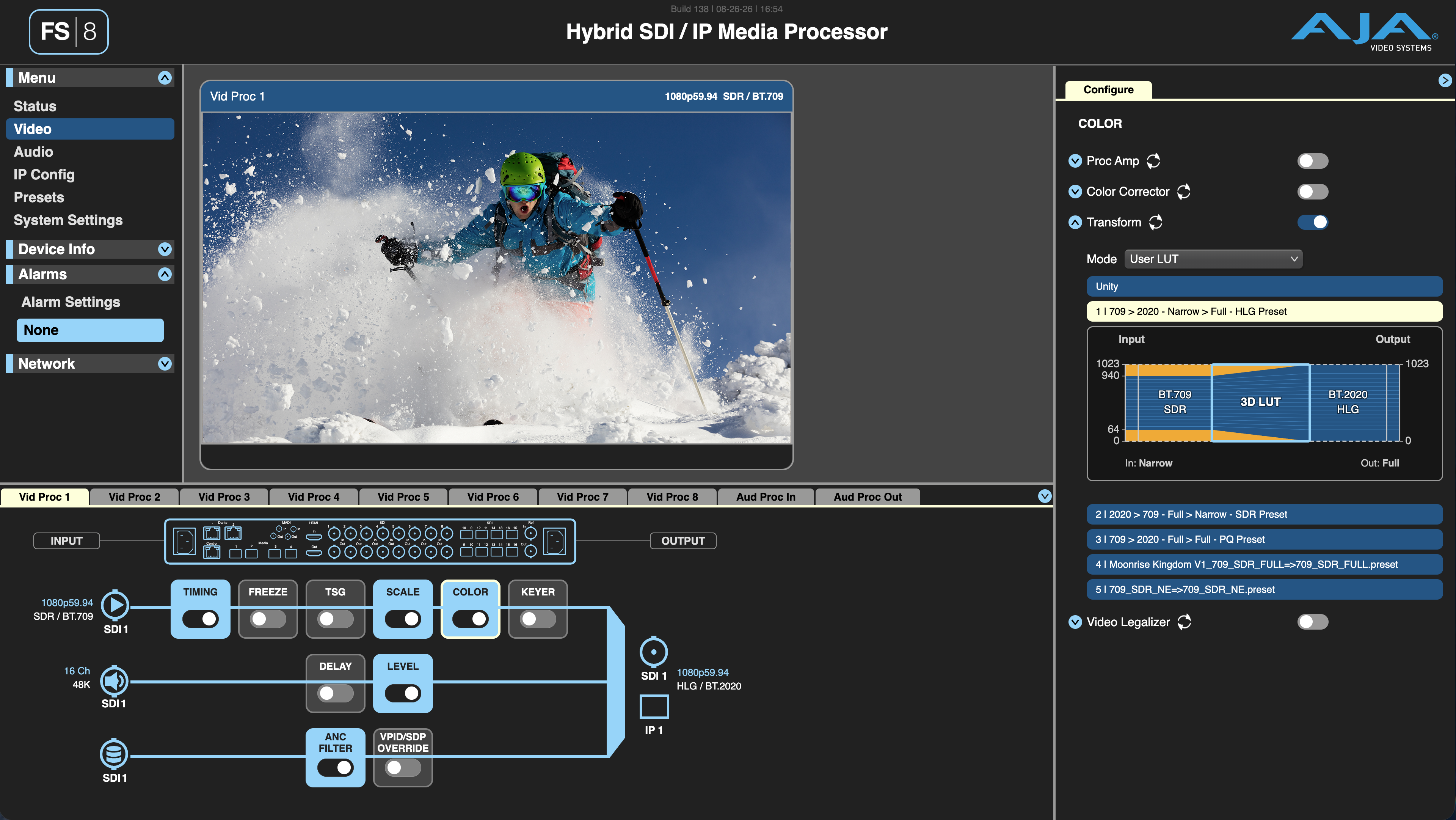
FS8 supports uploads of user-created 3D LUTs, with the ability to store and recall as needed through the FS8’s new and easy-to-use 3D LUT Preset UI. 3D LUTs are ideal for SDR/HDR transforms, bringing a standard desired look to a production, and for applying creative LUTs for imagine enhancements and special visual treatments. FS8 supports 33-point Tetrahedral 3D LUT interpolation.

FS8 also supports Dynamic LUT uploads from third-party software for live color grading, with the ability to see changes as you implement them. For example, Pomfort LiveGrade software drives FS8’s Dynamic LUTs for continuous real-time LUT updates. 
BBC HLG LUTs

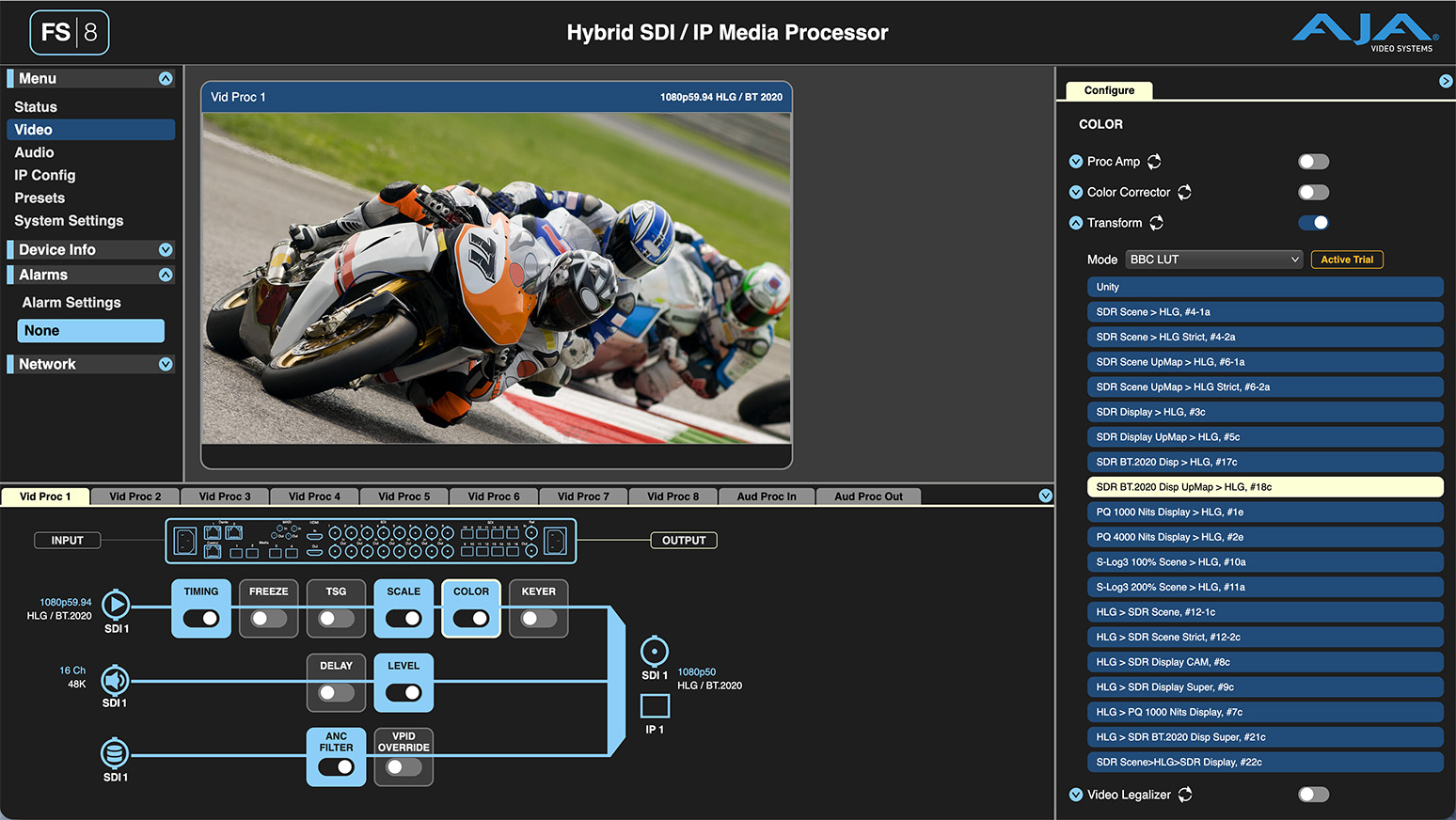
BBC HLG LUTs Mode offers additional functionality that adds HDR conversion options, particularly for television broadcasters who are looking for specific conversion criteria as a licensable option in FS8.
  • Supports mathematical HLG HDR dynamic range mapping per ITU BT.2408 
  • Scene-light and Display-light conversions 
  • SDR, PQ, and S-Log3 to HLG 
  • HLG to SDR and PQ 
  • Utilizes 33-point Tetrahedral 3D LUT Interpolation 

NBCU LUTs

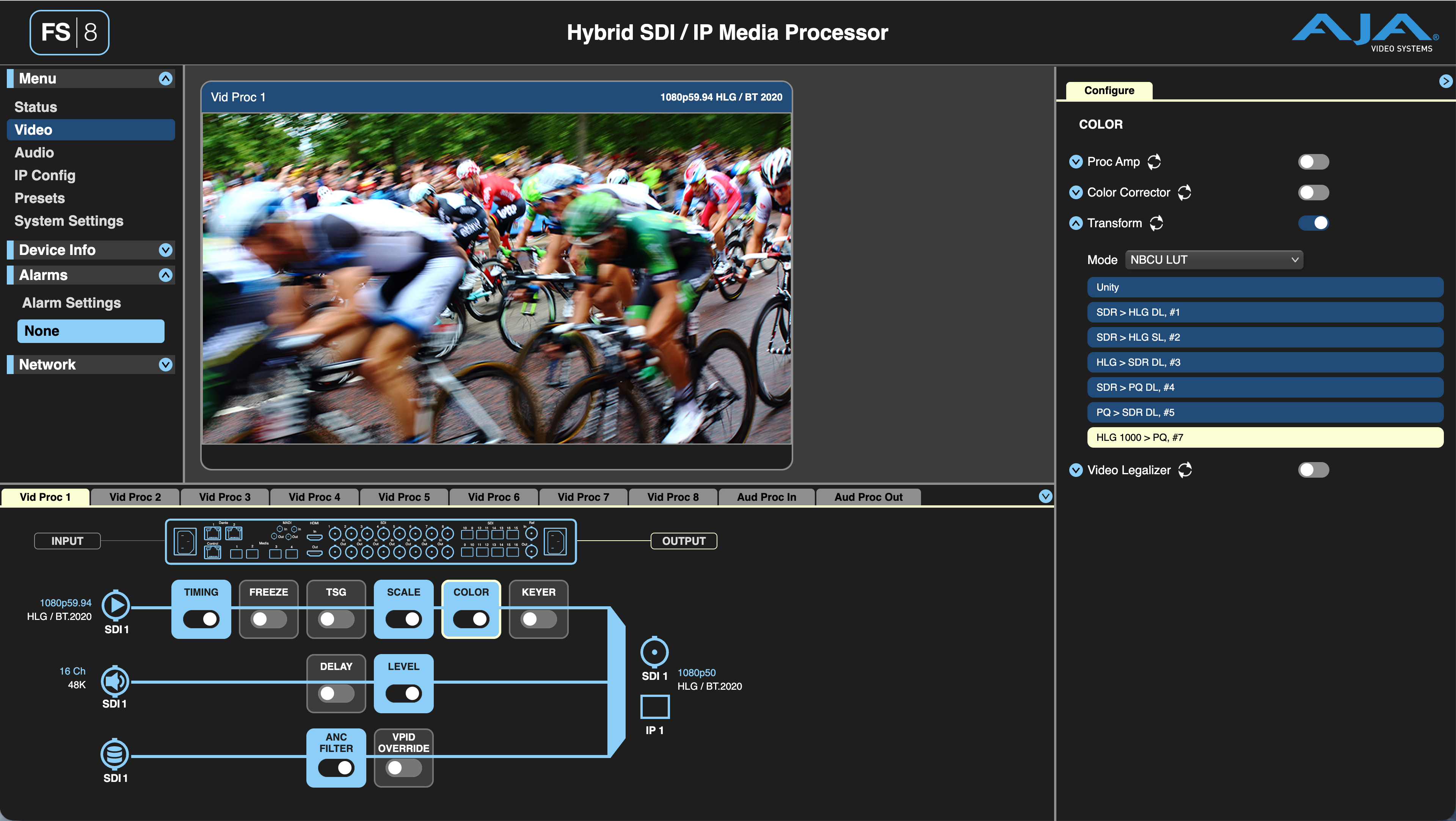
NBCU LUTs, developed by NBCUniversal Media, LLC in collaboration with Cromorama, enable a workflow for single-master live production of simultaneous HDR and SDR content. Designed for television broadcasters, NBCU LUTs include SDR, HLG, and PQ LUTs that maximize the dynamic range and color volume in HDR, without compromising core SDR broadcasts and are included with FS8.
  • Imperceptible roundtripping of SDR BT.709  
  • Conversions designed with a knee that is natural with latitude for live video shading 
  • Scene-light and Display-light conversions 
  • SDR, HLG, and PQ conversions 
  • Utilizes 33-point Tetrahedral 3D LUT Interpolation

Partner Integrations

To control FS8’s rich feature set beyond the built-in web UI, we offer a comprehensive set of tools to enable third parties to develop their own native control. Using the OpenAPI framework for the REST API, the protocol is presented intuitively, allowing both humans and computers to discover, interact, and understand FS8 capabilities.

Pomfort

Pomfort Livegrade 

Pomfort officially supports FS8 as a network-connected look management device. Livegrade connects to the FS8 by IP address, can address its individual video processors, and sends 3D LUT updates dynamically for real time processing by FS8. 

“For years, Livegrade has helped cinematographers and film production teams preserve their creative intent throughout complex multi-camera productions. As live productions continue to embrace cinematic image quality and modern IP infrastructures, the integration with the new AJA FS8 extends Livegrade's proven capabilities into SMPTE 2110 workflows for FullHD and UHD signals. We're excited to support this evolution by enabling live production teams to achieve cinematic-level creative control all the way through to the audience, while meeting the speed, scale, and no-second-chance demands of live environments.” - Lukas Wanderer, Product Manager at Pomfort

https://pomfort.com/

Skaarhoj

SKAARHOJ’s line of hardware-based control panels provides integrated control of AJA’s FS family of frame synchronizers. The Rack Control Duo, developed in partnership with broadcast services provider NEP, supports AJA’s FS8, FS-HDR, FS4, FS2, and FS1-X devices and is capable of ganging control of multiple FS products and processing channels together, making set-up and on-the-fly adjustments faster and easier for operators and engineers with a single tactile hardware control panel.

Ideal for any production environment involving multiple source signals, Rack Control Duo is an intuitive hardware control panel with tactile knobs and buttons to easily perform simultaneous adjustments across multiple AJA frame synchronizers.

Operators can also use the panel to recall and implement presets from previous setups across one or more FS devices. When used in conjunction with FS8’s real time HDR/WCG converters, RGB color corrections can be performed via Rack Control Duo prior to HDR to SDR or SDR to HDR transforms, harnessing the power of AJA’s FS8.

https://www.skaarhoj.com/

CyanView

CyanView RCP connects to the AJA device over the same network and allows operators to control FS8’s video processor Proc Amps and RGB Color Correctors directly from the CyanView RCP. This option is available independently of camera control but can also be combined in a mode where the RCP would control both the camera and the color corrector simultaneously, providing the missing paint functions to the camera and a tactile control surface for the FS8.

https://www.cyanview.com/ 

Industry Leading Support

AJA’s technical support is recognized as among the best in the industry and is available to all AJA customers. If you need assistance with any aspect of your FS installation, configuration, operation or encounter any technical issues, AJA Support will work with you to get up and running. 

FS products are covered by a generous five-year warranty. Please see the individual Product’s Manual for additional specifics around warranty conditions for the product itself.


Tech Specs

Tech Specs are subject to change.


HDR/WCG Real Time Processor

  • HDR Conversions
    • HDR to HDR
    • HDR to SDR
    • SDR to HDR
  • Colorimetry
    • BT.709 and BT.2020

Video Processing Transforms

  • Each processing channel can independently select from:
    • Colorfront Engine
    • NBCU 3D LUTs
    • BBC HLG 3D LUTs
    • User 3D LUTs
    • Dynamic 3D LUTs

Colorfront Engine (CFE) Advanced HDR Conversions
 

  • Processing Based on Human Perception Model
  • Perceptually optimized color volume remapping 
  • Preserves the original creative intent
  • Parametric controls including HDR functions and color corrector
  • TV Mode for applications such as television broadcast
  • Live Mode for applications such as broadcast, OTT, A/V
  • Film Mode for applications such as on-set camera preview and look creation
  • SDR to Dolby Vision Preview Mode for applications supporting Dolby Vision grading workflows
  • Input Video Dynamic Range/Color Gamut
    • SDR BT.709 100 Nits
    • SDR Extended BT.709
    • PQ BT.2020 1000 Nits
    • PQ P3D65 1000 Nits 
    • P3D65 Gamma 2.6 (Live mode only)
    • Hybrid Log Gamma BT.2100
    • HLG Extended BT.709
    • HLG Extended BT.2100
    • Sony S-Log3 S-Gamut3
    • Sony S-Log3 S-Gamut3 Cine 
    • Sony S-Log3 BT.2020
    • ARRI Log C Wide Gamut                                                  
    • ARRI LogC4 Wide Gamut 4
    • Panasonic V-log 
    • RED Log3G10 Wide Gamut 
    • Canon Log 2 
    • Canon Log 3
    • BMDFilm Wide Gamut Gen5 (Live mode only)
    • DJI D-Log D-Gamut (Live mode only)
    • ACEScct (Film mode only)
  • Output Video Dynamic Range/Color Gamut
    • SDR BT.709 100 Nits
    • SDR Extended BT.709
    • PQ BT.2020 1000 Nits
    • PQ P3D65 1000 Nits
    • PQ BT.2020 6000 Nits (Live mode only)
    • PQ BT.2020 6000 Nits ConstrainP3 (Live mode only)
    • PQ BT.2020 8000 Nits (Live mode only)
    • PQ BT.2020 8000 Nits ConstrainP3 (Live mode only)
    • PQ BT.2020 10000 Nits (Live mode only)
    • PQ BT.2020 10000 Nits ConstrainP3 (Live mode only)
    • Hybrid Log Gamma BT.2100
    • HLG Extended BT.709
    • HLG Extended BT.2100
    • Sony S-Log3 S-Gamut3
    • Sony S-Log3 BT.2020
    • ARRI Log C Wide Gamut
    • ARRI LogC4 Wide Gamut 4 
    • ACEScct (Film mode only)
  • SDR Preview mode
  • Ambient Light Compensation control
  • PQ Output Nit level: 48-10000 Nits
  • PQ Output P3 Colorspace Clamp
  • Exposure, Color Temp, Tint controls
  • TV Mode controls
    • Highlight management: Brightness, Highlight, Super Highlight
    • Color Correction: Lift, Gamma, Gain, Saturation
    • Camera Correction: Exposure, Color Temp, Tint
  • Live Mode controls
    • Grading: Lift, Gamma, Gain,
    • SDR Softness control
    • ITU-R BT.2408 control
  • Film Mode controls
    • Grading space: LogC, ACEScct, or S-Log3
    • ACES CDL: Offset, Power, Slope, Saturation     
    • A/B Look Selection
    • A/B Look Mix
      • MasterLook
      • MasterBroadcast
      • MasterLookBright
      • MasterLookCool
      • MasterLookLowCon
      • MasterLookSoftColor
      • MasterLookVivid
      • MasterLookWarm
      • MasterPastelD60
      • MasterPastelD65
      • Agfa
      • ARRI K1S1
      • Bleach
      • ClassicFilm
      • Ektachrome
      • FilmBlended
      • FilmBlendedLoCon
      • FujiDI
      • FujiXD
      • GenericFilm
      • Kodachrome
      • ReversalClassic
  • SDR to Dolby Vision Preview controls
    • Highlights: Low, Mid, High
    • Contrast: Low, Mid, High

BBC HLG 3D LUT HDR Conversions

  • Mathematical dynamic range mapping per ITU-R BT.2408
    • SDR/BT.709 Scene Referred to HLG/BT.2100 v1.7
    • SDR/BT.709 Scene Referred to HLG/BT.2100 Strict v1.7
    • SDR/BT.709 Scene Referred UpMap to HLG/BT.2100 v1.7
    • SDR/BT.709 Scene Referred UpMap to HLG/BT.2100 Strict v1.7
    • SDR/BT.709 Display Referred to HLG/BT.2100 v.1.7
    • SDR/BT.709 Display Referred UpMap to HLG/BT.2100 v1.7
    • SDR/BT.2020 Display Referred to HLG/BT.2100 v1.7
    • SDR/BT.2020 Display Referred UpMap to HLG/BT.2100 v1.7
    • PQ 1000 Nits Display Referred to HLG/BT.2100 v1.7
    • PQ 4000 Nits Display Referred to HLG/BT.2100 v1.7
    • S-Log3/BT.2020 100% Scene Referred to HLG/BT.2100 v1.7
    • S-Log3/BT.2020 200% Scene Referred(SR-Live) to HLG/BT.2100 v1.7
    • HLG/BT.2100 to SDR/BT.709 Scene Referred v1.7
    • HLG/BT.2100 to SDR/BT.709 Scene Referred Strict v1.7
    • HLG/BT.2100 to SDR/BT.709 Display Referred Color Appearance Model v1.7
    • HLG/BT.2100 to SDR/BT.709 Display Referred Super White v1.7
    • HLG/BT.2100 to PQ 1000 Nits Display Referred v1.7
    • HLG/BT.2100 to SDR/BT.2020 Display Referred Super White v1.7
    • SDR/BT.709 Scene Referred UpMap to HLG/BT.2100 to SDR/BT.709 Display Referred v1.7

NBCU 3D LUT Processing

  • NBCU LUTs developed by NBCUniversal Media, LLC
    • 1-NBCU_SDR2HLG_DL_v1.1, SDR UpMap to HLG using Display Light v1.1
    • 2-NBCU_SDR2HLG_SL_v1, SDR to HLG using Scene Light v1.0
    • 3-NBCU_HLG2SDR_DL_v1.1, HLG to SDR using Display Light v1.1
    • 4-NBCU_SDR2PQ_DL_v1, SDR UpMap to PQ using Display Light v1.0
    • 5-NBCU_PQ2SDR_DL_v1, PQ to SDR using Display Light v1.0
    • 7-NBCU_HLG10002PQ_v1, HLG 1000 Nits to PQ v1.0

User 3D LUT Processing

  • Supports custom 33 point .cube format 3D LUTs
  • Tetrahedral LUT interpolation
  • Configurable Colorimetry, Transfer Characteristic, Signal Range
  • Nonvolatile storage of 16 fixed LUTs

Dynamic 3D LUT Processing

  • Supports third party apps for automatic loading and processing of 3D LUTs 
  • Reflects dynamic changes in real time from source software
  • Supported by Pomfort Livegrade Pro

Video Formats
 

  • (4K) 4096x2160p 23.98, 24, 25, 29.97, 30, 50, 59.94, 60
  • (UltraHD) 3840x2160p 23.98, 24, 25, 29.97, 30, 50, 59.94, 60
  • (2K) 2048x1080p 23.98, 24, 25, 29.97, 30, 50, 59.94, 60
  • (HD) 1920x1080p 23.98, 24, 25, 29.97, 30, 50, 59.94, 60
  • (HD) 1920x1080PsF 23.98, 24, 25, 29.97, 30
  • (HD) 1920x1080i 50, 59.94, 60
  • (HD) 1280x720p 50, 59.94, 60

Video Inputs

  • 8x 12G-SDI inputs, 8x BNC
    • 12G/6G/3G/HD, SMPTE 292/424/2081/2082
      • YCbCr, 4:2:2, 10-bit
      • Single Link 12G/6G-SDI
      • Single Link 3G-SDI Level A, SMPTE 425
      • Single Link 1.5G-SDI
  • 8x Fiber or HD-BNC (optional SFP modules)
    • SFP coax module, 12G/6G-SDI, dual HD-BNC
    • SFP fiber module, 12G/6G-SDI, Single Mode, dual LC or single LC, SMPTE 297
    • SFP fiber module, 3G-SDI, Single Mode, dual LC, single LC, or single SC, SMPTE 297
    • SFP fiber module, 3G-SDI, Multi-Mode, dual LC or single LC, SMPTE 297
  • 4x UHD or 8x HD, SMPTE ST 2110-20 Video
    • YCbCr 4:2:2 10-bit
    • RX support for Class-A, B, C, D SMPTE ST 2022-7 redundancy
    • Rx support for Narrow and Wide Senders

Video Outputs 

  • 8x 12G-SDI outputs
    • 12G/6G/3G/HD, SMPTE 292/424/2081/2082
      • YCbCr, 4:2:2, 10-bit
      • Single Link 12G/6G-SDI
      • Single Link 3G-SDI Level A, SMPTE 425
      • Single Link 1.5G-SDI
  • 8x Fiber or HD-BNC (optional SFP modules)
    • SFP coax module, 12G/6G-SDI, dual HD-BNC
    • SFP fiber module, 12G/6G-SDI, Single Mode, dual LC or single LC, SMPTE 297
    • SFP fiber module, 3G-SDI, Single Mode, dual LC, single LC, or single SC, SMPTE 297
    • SFP fiber module, 3G-SDI, Single Mode, dual LC, SMPTE 297 
    • SFP fiber module, 3G-SDI, Multi-Mode, dual LC or single LC, SMPTE 297
  • 4x UHD or 8x HD, SMPTE ST 2110-20 Video
    • YCbCr 4:2:2 10-bit
    • Tx support for SMPTE ST 2022-7
    • Tx senders are Narrow Gapped

Media Interfaces (In-Band)

  • 4x SFP28 Cages 
    • Supports 10 GigE and 25 GigE SFPs (SFPs not included)
  • Uncompressed media (SMPTE ST 2110-20, 30, 40)
  • PTP
  • NMOS Discovery, Registration, and Control
    • NMOS Tx/Rx support according to standards IS-04 v1.3 and IS-05 v1.1
    • LLDP
    • In-Band and Out-of-Band
    • L2, L3 with SSM
    • IGMP v2, v3

Operating Modes

  • SDI Only Mode: Supports up to 16x16 12G-SDI (8x8 SDI BNC and 8x8 SDI SFPs, optical and HD-BNC)
  • Hybrid Mode 1: Supports mix of 8x8 12G-SDI BNC and ST 2110 
  • Hybrid Mode 2: Supports mix of 8x8 12G-SDI SFPs (optical and HD-BNC) and ST 2110 

IP Gateway

  • 8x HD (where "x" is a gateway in or out) 
  • 4x UHD  


Examples:

  •  4+0, 2+2, 0+4 UHD (where 4+0 is 4 IP inputs to 4 UHD Vid Procs to 4 SDI and or IP outputs and 0 SDI to IP gateways) 
  •  8+0, 4+4, 0+8 HD (where 8+0 is 8 IP inputs to 8 HD Vid Procs to 8 SDI and or IP outputs and 0 SDI to IP gateways) 

Video Processing

  • Frame synchronization
  • Up, Down, Cross conversion
  • Frame rate conversion
  • Motion adaptive deinterlacer
  • Proc amp controls
  • Color corrector
  • Color transforms
  • Legalizer
  • Freeze (manual or on input signal loss)
  • Matte generator for background fill
  • Test signal generator, SDR and HDR patterns, moving box, text overlay
  • Nominal video delay 2 frames
  • Adjustable delay (0-30 frames UHD, 0-60 frames HD) with H and V timing controls in pixels and lines

Ancillary Data

  • All embedded ANC packets pass-through when output format equals input format
  • Ancillary Timecode (LTC, VITC1, VITC2) pass-through for wide range of conversions
  • SCTE-104 and Closed Captioning pass-through for wide range of conversions
  • Configurable output VPID / SDP for Colorimetry, Transfer Characteristic, and Signal Range
  • SMPTE ST 2110-40 Ancillary

Scaling

  • Supported in 4K/UltraHD/2K/HD formats
    • Zoom in and out
    • Reposition
    • Region of Interest (ROI)
    • Video processor layering, max 2

Audio Inputs

  • 48 kHz sample rate
  • 16x SDI embedded inputs (16-channels each)
    • 128-channels, 24-bit, 48 kHz synchronous, SMPTE 299
  • 4x UHD or 8x HD SMPTE ST 2110-30 Audio input streams
    • 1x16, 2x8, 4x4 modes, up to 16-channels audio per stream, 24-bit, 48 kHz synchronous
    • 1ms and 125us timing
  • DANTE input, 2x RJ-45 (Primary and Secondary)
    • 64-channels, 44.1kHz, 48kHz, 88.2kHz, 96kHz (Sample Rate Converted to 48 kHz)
    • PCM 16, PCM 24, PCM 32
  • 2x MADI inputs, (56 or 64-channels each), 2x HD-BNC
    • 128-channels, 24-bit, AES-10

Audio Outputs

  • 48 kHz sample rate
  • 1x embedded output per Video Processor (16-channels each)
    • 128-channels, 24-bit, 48 kHz synchronous, SMPTE 299
  • 4x UHD or 8x HD ST 2110-30 Audio output streams
    • 1x16, 2x8, 4x4 modes, up to 16-channels audio per stream, 24-bit, 48 kHz synchronous
    • 1ms and 125us timing
  • DANTE output, 2x RJ-45 (Primary and Secondary)
    • 64-channels, 48kHz synchronous
    • PCM 16, PCM 24, PCM 32
  • 2x MADI outputs, 2x HD-BNC
    • 128-channels, 24-bit, AES-10

Audio Processing

  • 459 x 448 mono audio matrix, route 1 to 1, 1 to many
    • Inputs: 256 SDI embedded, 128 SMPTE 2110-30, 64 DANTE, 128 MADI, 4 stereo mixdowns (8-channels), 3 tone generators
    • Outputs: 128 from Vid Procs (to SDI embedded and ST 2110-30 streams), 64 DANTE, 128 MADI
  • Input adjustment controls for each channel
    • Gain +18 to -18 dB in 0.5 dB steps
    • Phase invert
  • Input adjustment controls for each channel
    • Delay 0sec to +0.25sec in 20.8 us steps
  • Audio delay can automatically follow video timing delay adjustments
  • Four independent 5.1 or 7.1 to stereo mixdown processors with gain adjust
  • High quality Sample Rate Conversion supported on all audio inputs
  • SRC bypass for non-PCM audio (e.g. Dolby E, AC-3, etc)
  • Output adjustment controls for each channel
    • Gain +18 to -18 dB in 0.5 dB steps
    • Phase invert
  • Output adjustment controls for each channel
    • Delay 0sec to +2.5sec in 20.8 us steps
  • Test signal generator (Silence, 400 Hz, 1 kHz)
  • Audio group control

Analog Reference Input

  • External, 1x BNC
    • Blackburst or tri-level sync

Analog Reference Output

  • External, 1x BNC
    • Blackburst or tri-level sync
    • Configurable

Genlock

  • Analog Reference Input
  • PTPv2 SMPTE ST 2059-2 / IEEE 1588-2008
    • In-Band only
  • Free run

Control Network Interfaces

  • 1x RJ-45, 10/100/1000 Ethernet
    • Embedded web server for remote control
    • REST Interface
  • 2x RJ-45, 10/100/1000 Ethernet
    • DANTE Controller
  • 4x SFP28 Media Interfaces
    • NMOS Discovery, Registration, and Control

User Interfaces

  • AJA webUI
  • DANTE Controller, Dante Domain Manager & Network Management Applications 
  • Color LCD Display with backlit button keypad
  • Two rotary/push knobs
  • LED alarm indicators

Presets

  • System, Video Processor, Audio Processor, User 3D LUT, IP Config, and component levels within

Size (w x d x h)

  • 17.5” x 16.0” x 1.75” (1RU) (444.5 x 406.4 x 44.45 mm)

Weight

  • 7.9 lb (3.6 kg)

Power

  • 100-240 VAC 50/60 Hz (Dual, redundant power supplies), 70W typical; 90W max.

Environment

  • Safe Operating Temperature: 0 to 40 C (32 to 104 F)
  • Safe Storage Temperature (Power OFF): -40 to 60 C (-40 to 140 F)
  • Operating Relative Humidity: 10-90% noncondensing
  • Operating Altitude: <3,000 meters (<10,000 feet)


Options


FS8 is a hybrid SDI/IP Media Processor with powerful color management tools with a number of options that extend its functionality even further. These options include the Colorfront Engine, and the BBC HLG LUTs. These options are all free to try for 15 days and can be licensed individually with perpetual licenses. 

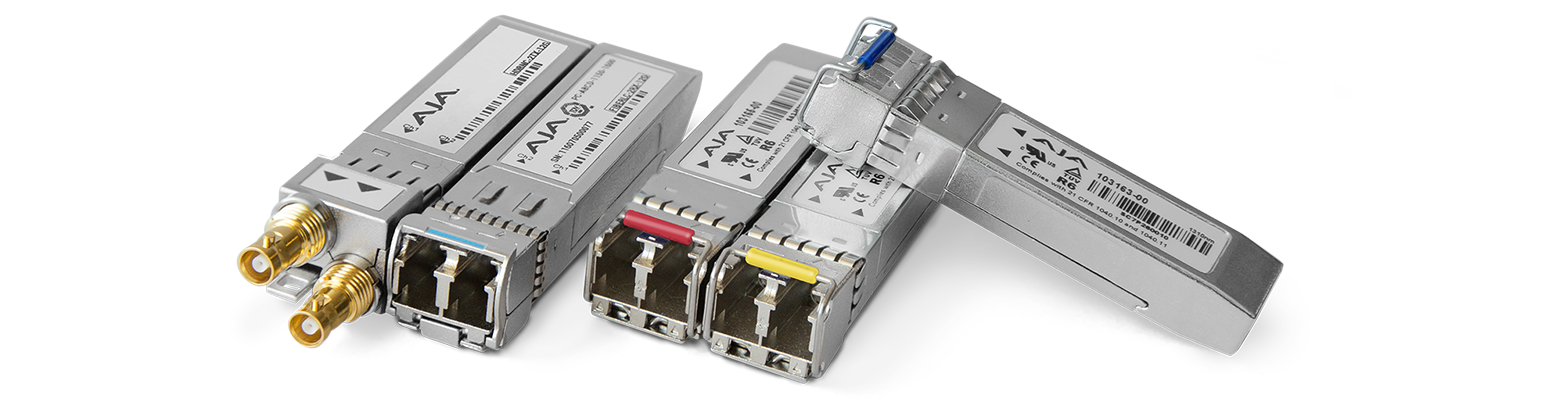
FS8 supports a wide range of compatible SDI SFP modules for expanding 12G-SDI I/O with HD-BNCs or fiber optics for long distance signal transport and fiber conversion, providing flexible connectivity for a variety of production environments. 

Colorfront Engine TV Mode

Colorfront’s TV,Live, and SDR to Dolby Vision Preview Modes are now available as a single licensable option in FS8. 

TV Mode is an intuitive color processing engine aimed at broadcast workflows that contains built-in SDR, HLG and PQ transforms. This license enables parametric controls and S-Log3 transforms of TV Mode. The same license also enables Colorfront Live Mode, which includes HDR/SDR, HLG and PQ conversions and supports popular camera log formats, including ARRI LogC4, Sony S-Log3, Panasonic V-Log, Canon Log, and others. Colorfront SDR to Dolby Vision Preview mode converts SDR to perceptually matched HDR using Colorfront Transkoder’s SDR2DolbyVision color transforms, with adjustable highlight and contrast controls that can be reproduced downstream in Transkoder for final Dolby Vision deliverables. 

Optional License FS8-LIC-CF - $1,995 

BBC HLG LUT Mode Option 

BBC HLG LUTs offers additional functionality that adds field proven HDR conversion options, particularly for television broadcasters who are looking for specific conversion criteria. This mode includes an RGB Color Corrector and Proc Amp to color correct the signal prior to conversion. 

Optional License FS8-LIC-BBC - $295 

These optional licenses are available to purchase at: 
https://www.aja.com/products/fs8/license 

12G/6G HD-BNC and Fiber SFP Options

FS8's SFP options include both 12G/6G-SDI HD-BNC and LC Fiber I/O options, including single and dual channel Single Mode options and Multi-Mode options, allowing great SDI flexibility and fiber cable runs of up to 10 kilometers to be connected directly to the FS8 without the need for separate fiber to SDI conversion.

Also available are 3G-SDI Fiber LC and SC SFP options.

Use the AJA SFP Configurator to choose and order your SFPs. 

SFP Configurator

Optional 12G/6G-SDI SFPs:

  • HDBNC-2TX-12G:  12G/6G-SDI Dual Coax HD-BNC Transmitter
  • HDBNC-2RX-12G:  12G/6G-SDI Dual Coax HD-BNC Receiver
  • FIBERLC-1TX-12G:  12G-SDI Single Fiber LC Transmitter Single Mode 1310nm
  • FIBERLC-1RX-12G:  12G-SDI Single Fiber LC Receiver Single Mode 1310nm
  • FIBERLC-2TX-12G: 12G/6G-SDI Dual Fiber LC Transmitter Single Mode 1310nm 
  • FIBERLC-2RX-12G: 12G/6G-SDI Dual Fiber LC Receiver Single Mode 1310nm

Optional 3G-SDI Single Mode SFPs:

  • FIBERSC-1-TX:  3G-SDI Single Fiber SC Transmitter Single Mode 1310nm
  • FIBERSC-1-RX:  3G-SDI Single Fiber SC Receiver Single Mode 1310nm
  • FIBERLC-1-TX:  3G-SDI Single Fiber LC Transmitter Single Mode 1310nm
  • FIBERLC-1-RX:  3G-SDI Single Fiber LC Receiver Single Mode 1310nm
  • FIBERLC-2-TX:  3G-SDI Dual Fiber LC Transmitter Single Mode 1310nm
  • FIBERLC-2-RX:  3G-SDI Dual Fiber LC Receiver Single Mode 1310nm

Optional 3G-SDI Multi-Mode SFPs:

  • FIBERLC-1TX-MM:  3G-SDI Single Fiber LC Transmitter Multi-Mode 850nm
  • FIBERLC-1RX-MM:  3G-SDI Single Fiber LC Receiver Multi-Mode 850nm
  • FIBERLC-2TX-MM:  3G-SDI Dual Fiber LC Transmitter Multi-Mode 850nm
  • FIBERLC-2RX-MM:  3G-SDI Dual Fiber LC Receiver Multi-Mode 850nm


ST 2110 Media Port SFPs 

ST 2110 SFPs are not included and must be purchased separately.  Please note that the SMPTE ST 2110 SFP options must be purchased separately from sources like www.FS.com


Sign-up with AJA!

Receive the latest news and product update information

Submit and Download

Continue to Download without Sign-up

Your details will be registered with the AJA Video Systems database to receive occasional news of important software updates, new products and services. Please view our privacy policy for more information.